
A Startup’s Guide to Embargoed Press Releases
January 18, 2026
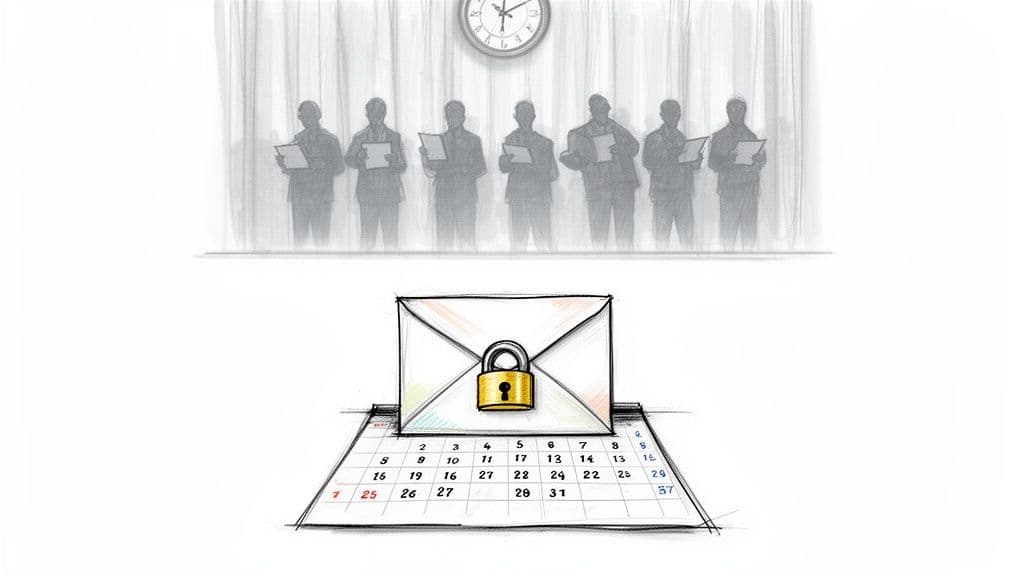
An embargoed press release is essentially a gentleman's agreement with the media. You're giving a select group of journalists a sneak peek at your big news before it goes public. In exchange for this early access, they promise not to publish their story until a specific date and time you've set.
Think of it as giving a movie critic a private screening before opening night. It gives them the time and space to write a thoughtful, in-depth review instead of a rushed, surface-level summary. This simple act of trust can transform a standard announcement into a major media event.
Understanding Embargoed Press Releases
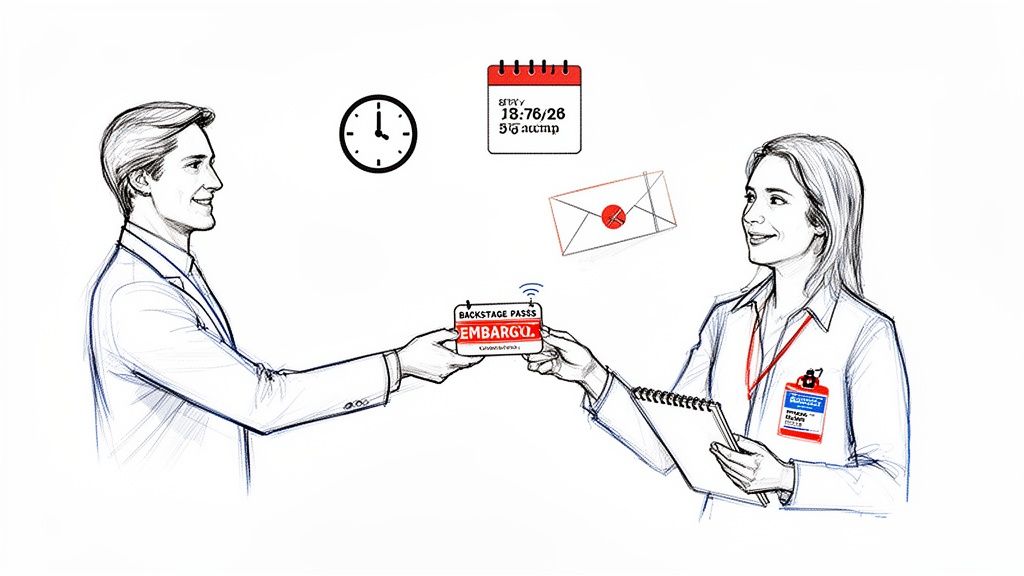
Instead of just blasting out your news and hoping for the best, an embargo lets you orchestrate a coordinated wave of coverage. It’s the difference between a firecracker and a fireworks show. You're not just informing reporters; you're equipping them to tell your story in a compelling and accurate way.
This advance notice is far more than a professional courtesy. It's a strategic tool that gives journalists the breathing room they need to line up interviews, gather extra data, and produce the kind of well-researched pieces that truly move the needle.
The Core Agreement
At its heart, the embargo is a straightforward pact. You provide sensitive information ahead of schedule, and the journalist agrees to honor the release time. It's a handshake deal that forms the bedrock of many successful PR campaigns.
An embargo allows you to shape the story before it hits the headlines, turning a reactive announcement into a proactive media strategy. It gives you control over the timing and initial narrative of your company's biggest moments.
For a startup announcing a new funding round or a major product launch, this can mean the difference between a forgotten blip and a feature story that defines their market position. Getting the specifics right is crucial, and you can learn more about how to prepare an embargo news release in our detailed guide.
Choosing between an embargoed release and an immediate one depends entirely on your goals. Here’s a quick breakdown to help you decide.
Embargoed Release vs Immediate Release
| Aspect | Embargoed Press Release | Immediate Release |
|---|---|---|
| Timing | Sent in advance with a future publication date/time. | Sent out for immediate publication upon receipt. |
| Goal | Generate in-depth, coordinated, and impactful coverage. | Disseminate news quickly and widely. |
| Best For | Major launches, funding rounds, complex announcements. | Minor updates, time-sensitive news, routine announcements. |
| Media Relationship | Builds trust and relationships with key journalists. | Transactional; less focus on relationship-building. |
| Coverage Quality | Tends to be more detailed, accurate, and thoughtful. | Often results in shorter, summary-style articles. |
| Control | High control over the initial narrative and launch timing. | Less control once the release is sent. |
Ultimately, an embargoed release is a strategic choice for news you want to make a significant impact with, while an immediate release is a tactical tool for getting information out fast.
Key Benefits at a Glance
So, why go through the extra effort of coordinating an embargo? The payoff can be huge, especially when you need your announcement to land with maximum force.
- Deeper Coverage: Journalists have the time they need to go beyond a simple summary, resulting in richer, more detailed articles that tell your whole story.
- Increased Accuracy: More time for fact-checking and follow-up questions means the final stories are far less likely to contain errors or misinterpretations.
- Stronger Media Relationships: Offering early, exclusive access is a powerful way to build trust and goodwill with the reporters who matter most in your industry.
- Coordinated Impact: Imagine several high-quality stories from respected outlets all breaking at the same time. This creates a powerful "media moment" that amplifies your reach and lets you own the news cycle.
The Strategic Advantage of a Coordinated Media Launch
Think of an embargo as the difference between a single, lonely firecracker and a full-blown fireworks finale. Instead of a drip-feed of news, you get to create a powerful ‘media wave’ where multiple, high-quality stories about your company all break at the same time. This is how you dominate the news cycle in your industry, even if just for a day.
This synchronized approach makes your announcement feel like a significant, memorable event, not just another passing blip on the radar. By controlling the timing, you amplify your message, establish instant credibility, and get to frame the story on your own terms right from the start.
Building Trust Through Early Access
Giving a reporter early access under embargo does more than just help them beat a deadline. It's a signal of trust and respect. You’re telling them they're a valued partner in telling your story, not just a megaphone for your press release.
This simple act of professional courtesy gives them the breathing room to do their best work. With a little extra time, they can move beyond a quick rewrite and dig in—conducting interviews, gathering outside opinions, and crafting a genuinely insightful article. For startups, understanding this dynamic is a crucial piece of the puzzle when launching a SaaS product and building a solid media strategy.
A well-executed embargo transforms a simple press release into a feature story. That deeper level of engagement is what really moves the needle, driving investor interest and user sign-ups by providing social proof from multiple trusted sources at once.
Maximizing Impact and Accuracy
That lead time an embargo provides is absolutely critical for quality journalism. Reporters can explore the context behind your announcement, which leads to stories that are not only more comprehensive but also far more accurate. This dramatically lowers the risk of the misinterpretations and factual errors that inevitably happen when a journalist is rushing to publish.
This controlled environment is particularly crucial for sensitive or market-moving news. For instance, in the financial world, a study of NYSE firms discovered that using embargoes cut down on premature leaks by 25-35%, helping to prevent unnecessary stock volatility. It’s a practice so vital that today, around 80% of financial journalists regularly honor embargoes to maintain their access and competitive edge. You can find more on the history and impact of news embargoes and why they've become an industry standard.
This coordinated approach delivers a few key wins:
- Dominates the Narrative: When several positive stories appear at once, your news instantly feels more important and credible.
- Amplifies Social Proof: Coverage from respected outlets acts as a powerful, third-party endorsement for your brand.
- Reduces Inaccuracies: Giving journalists time to do their homework results in higher-quality, error-free reporting.
- Strengthens Media Relationships: Offering exclusives is a great way to build a foundation of trust for future announcements.
Ultimately, a coordinated launch turns your news into an event. It generates the kind of momentum that a scattered, piecemeal release simply can't compete with.
Navigating Embargo Risks and Media Etiquette
An embargoed press release is a powerful tool, but it’s one built almost entirely on trust. Think of it as a professional handshake between you and a journalist—it’s not a legally binding contract. When that trust gets broken, the consequences can completely derail a media launch you've spent months planning.
The biggest risk you'll face is an embargo break. This is when a reporter publishes your story before the date and time you both agreed on. While it's often an honest mistake, a break can instantly kill your strategy, forcing you to play defense instead of controlling the narrative. This is why getting the etiquette right isn’t just about being polite; it’s about protecting your announcement's one big shot at making an impact.
The Unwritten Rules of Engagement
The golden rule of embargo etiquette is getting a clear "yes" from the journalist. Never just email a release with "EMBARGOED" slapped on it and assume they'll honor it. The professional way to do it is to pitch the story concept first, without giving away all the juicy details.
Once the journalist shows interest and explicitly agrees to your embargo terms, then you send them the full press release and media kit. This simple two-step dance confirms everyone is on the same page and dramatically cuts down the risk of accidental leaks from reporters who never actually agreed to anything.
An embargo is an agreement, not a command. Sending an unsolicited, embargoed press release and expecting it to be honored is a common mistake that can damage your reputation and lead to the very leaks you're trying to prevent.
Another key part of this is being incredibly selective about who you contact. Your energy is much better spent building relationships with a small circle of journalists who have a proven track record for being professional and trustworthy. A short list of reporters you can count on is always more valuable than a massive, unvetted one.
What Happens When an Embargo Breaks?
When someone jumps the gun, the fallout hits both sides of the relationship. Understanding these consequences is exactly why the system, for the most part, is respected and self-policing within the media world.
For the company, the damage is immediate and strategic:
- Loss of Momentum: The big wave of coverage you planned becomes a chaotic trickle, robbing your launch of its punch.
- Narrative Control Issues: The first story out the gate often sets the tone. If it's a rushed or inaccurate piece, it can frame public perception in a way that’s hard to fix.
- Uneven Playing Field: All the other journalists who respectfully held the story are now at a huge disadvantage, which can seriously strain those valuable relationships.
For the journalist and their outlet, the professional cost can be steep:
- Blacklisting: This is the most common outcome. They'll be cut off from future exclusives and early-access stories from your company, and word often gets around to others in your industry.
- Reputational Damage: Breaking an embargo is a major professional faux pas. It can seriously tarnish a reporter’s credibility with their peers and other sources.
In most cases, an accidental break can be smoothed over with an honest conversation. But a deliberate violation? That can burn a professional bridge for years. It's a risk few established journalists are ever willing to take.
Where Did the News Embargo Come From?
The news embargo feels like a modern PR tactic, but it’s actually a classic practice that’s been around for more than a century. It wasn't invented in a boardroom; it was forged out of necessity, born from a need to manage the release of critical information when the stakes were incredibly high.
Its most famous roots trace back to World War I. During the war, governments had to figure out how to keep journalists in the loop on military developments without tipping off the enemy or causing a panic back home. The embargo was the perfect solution: a gentleman's agreement that gave reporters the details they needed to write accurate stories, with the understanding that nothing would be published until it was safe.
From the Battlefield to the Stock Market
Once the war ended, this military tool quickly found a new home in the worlds of government and business. Organizations like the Bureau of Labor Statistics and the International Monetary Fund realized they could use embargoes to release market-moving economic data in a controlled, orderly way. This simple agreement helped prevent insider trading and kept financial markets from spiraling into chaos.
At its heart, the principle has always been the same: give trusted reporters a head start on a story to ensure accuracy and depth, in exchange for their promise to publish at a specific time. It’s a system built on mutual trust and respect, which is why it still holds up.
This is a delicate balance, of course. A recent Reuters Institute study revealed that while a small fraction of journalists—around 20-30%—admit to occasionally breaking embargoes, the overwhelming majority honor them. They know that maintaining that trust is the key to getting exclusive information in the future. You can dig into the numbers yourself in the full Reuters Institute report on newsroom practices.
Building Trust in Science and Media
The embargo became even more formalized in other fields, especially in scientific and academic circles. A major turning point came in the 1960s with the creation of the "Ingelfinger rule" by the New England Journal of Medicine.
This wasn't just a guideline; it was a policy. The journal declared it wouldn't publish any research that had already been covered by the media. This effectively created a powerful embargo system for scientific news, making sure that peer-reviewed studies were first presented with the proper context by the journal itself. It was a brilliant move to stop half-baked or sensationalized scientific claims from spreading like wildfire.
From national security and financial reports to groundbreaking medical research, the history of embargoed press releases tells a consistent story. It’s a strategic pact designed to bring order to chaos, ensuring that important news lands with thoughtfulness, accuracy, and maximum impact. This long history is exactly why it’s still such a powerful tool in any PR pro's arsenal.
How to Pitch and Manage Your Embargo
Running a successful embargoed release isn't about blasting out an email and hoping for the best. It’s a delicate process that requires planning, professionalism, and a genuine respect for the journalists you're working with. Getting it right can create a huge wave of coordinated media coverage.
The work starts long before you even think about hitting "send." It all begins with your media list. Forget about those massive, generic databases. You need a hand-picked list of journalists who genuinely cover your industry and, just as importantly, have a reputation for honoring embargoes. This isn't just good practice; it's your first line of defense against leaks.
The whole process can be broken down into three main stages, from identifying the right people to following up after you've sent the goods.
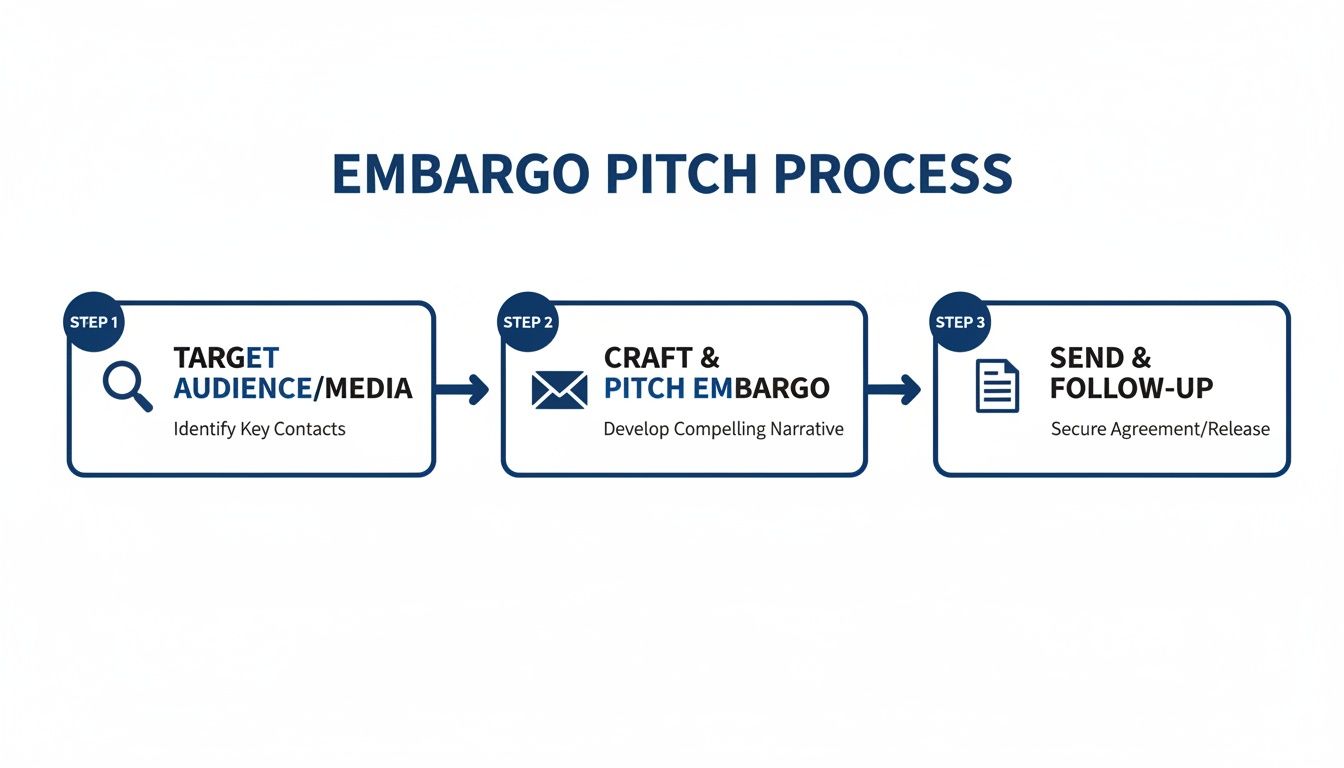
This workflow shows how you move from targeting the right reporters to pitching the idea, getting their buy-in, and finally sending over all the materials they need.
Step 1: Craft the Initial Pitch
Your first email to a journalist should never include the full press release. Instead, you send a short, intriguing "pre-pitch" to see if they're even interested and get their explicit agreement to the embargo. This is non-negotiable.
Give them a taste of the news—think "a major Series A funding announcement" or "a new AI product launch for the fintech space"—without spilling all the details. State the embargo date and time clearly, and then ask a simple question: "Are you interested and do you agree to the embargo?" For a deeper dive into crafting emails that reporters actually open, check out our guide on how to write pitches.
Step 2: Send the Embargoed Materials
Once a journalist gives you the green light, it's time to deliver the full package. This means sending the press release along with a complete media kit. The goal is to make their job as easy as possible. Of course, none of this matters if your email lands in their spam folder. A big part of this process is mastering email deliverability to ensure your news actually gets seen.
Most importantly, make the embargo terms impossible to miss.
EMBARGOED: NOT FOR RELEASE UNTIL 9:00 AM ET ON TUESDAY, OCTOBER 26
Put this exact line—with your specific date and time—at the very top of your email subject line and at the top of the press release itself. Repetition is your best friend here; it drastically reduces the chance of someone making an honest mistake.
Step 3: Prepare Your Media Kit
A great story needs great assets, so don't make journalists dig for them. Your media kit should be a comprehensive, one-stop shop with everything they need to build a rich, compelling article.
Here's what a solid media kit should include:
- High-Resolution Assets: This means professional headshots of your founders, crisp product screenshots, and your company logo in multiple formats (PNG, SVG, etc.).
- Prepared Quotes: Pull a few insightful quotes from your CEO or other key executives. This saves the journalist time and ensures your key messages are included.
- Boilerplate and Bios: Have your standard company boilerplate ready to go, along with short, professional bios for the main people involved in the announcement.
- Founder Availability: Let them know who is available for interviews and when. This adds a human touch and gives reporters a chance to get unique insights for their story.
By following these steps, you create a professional, trust-based system that sets you up for a powerful, coordinated media launch and minimizes the risk of your big news leaking early.
Modern Platforms for Embargoed Outreach
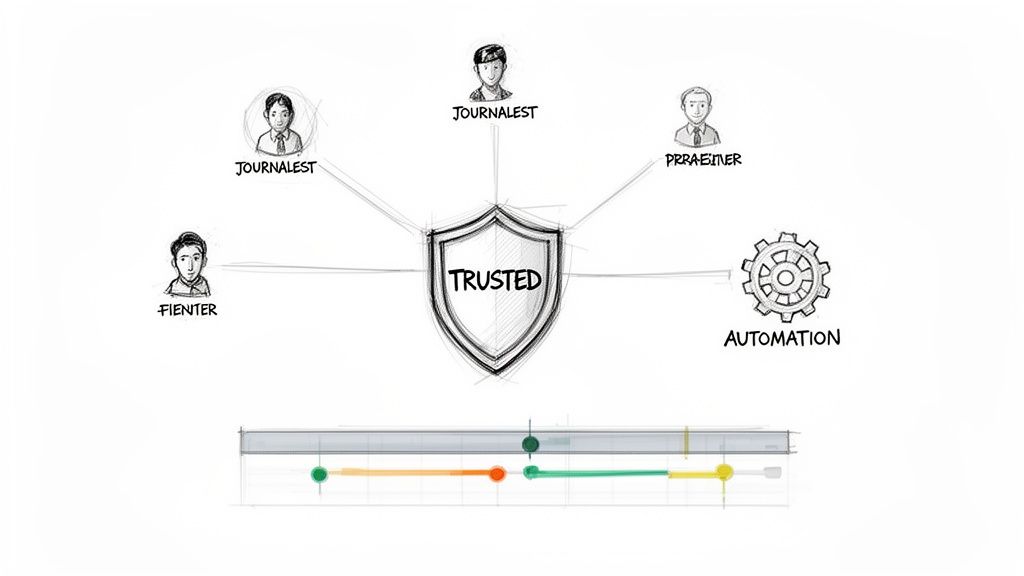
Trying to manage an embargoed press release manually is a bit like walking a tightrope. It demands painstaking research, constant tracking, and a whole lot of follow-up. One slip-up—a wrong email, a missed confirmation—and your entire launch strategy can come crashing down.
This is where modern PR platforms come in. They’re built to take the risk out of the equation by blending smart automation with human expertise. Instead of spending days digging through contacts, these tools can quickly pinpoint journalists who have a history of respecting embargoes, which instantly makes your campaign more secure.
Think of this technology as a command center for your entire outreach. It automates distribution, keeps a clear record of which journalists have agreed to your terms, and shows you in real-time who is engaging with your story. For startups, this level of control means they can secure predictable, impactful media coverage without the eye-watering cost of a traditional PR agency.
Streamlining the Workflow
The biggest win here is efficiency. A dedicated platform handles all the logistical grunt work, freeing up your team to focus on what humans do best: refining strategy and building genuine relationships with reporters.
Here’s how automation helps:
- Vetted Journalist Identification: Smart tools find reporters at top-tier outlets who not only cover your niche but also have a proven professional track record.
- Agreement Tracking: The system automatically logs every journalist's confirmation of the embargo, creating an undeniable paper trail of who has access to your news and when.
- Real-Time Analytics: Dashboards give you a live look at who’s opening your pitch, clicking your media kit, or replying. These insights are gold for understanding media interest.
By taking over the repetitive tasks, PR platforms allow founders and marketers to stop managing spreadsheets and start personalizing their story for the reporters who are genuinely interested.
For many startups, this is a total game-changer. Platforms like PressBeat use AI to send optimized pitches to high-authority outlets, guaranteeing publications for major announcements like funding rounds and product launches.
And it’s not just about getting the story out—it’s about getting it right. One analysis found that giving journalists lead time under an embargo can slash errors in science stories by 40%. Why? Because it gives them the breathing room to actually verify the facts. You can learn more about the impact of embargoes on reporting accuracy.
Picking the right platform is key to getting the most out of your announcement. If you're weighing your options, our guide on choosing the best press release distribution service can help you figure out which approach fits your goals and ensures your sensitive news is handled with the care it deserves.
Frequently Asked Questions About Embargoes
Even seasoned pros run into tricky situations with embargoes. It’s a strategy built on nuance and trust, so questions are bound to come up. Let’s walk through some of the most common ones we hear from founders and PR teams.
How Far in Advance Should I Send an Embargoed Pitch?
Finding the sweet spot for timing is crucial. For most news, pitching 3-5 business days ahead of your announcement is perfect. This gives a reporter enough breathing room to dig in and write a thoughtful piece, but it’s not so far out that your news gets buried in their inbox.
However, if you have a really complex story or you're aiming for a weekly magazine with longer lead times, you’ll want to push that out to 1-2 weeks in advance. Always think about the reporter's workflow and deadlines—it shows you respect their time.
What Happens If Someone Breaks My Embargo?
First things first: don't panic. Most embargo breaks are honest mistakes, not a malicious scoop. The moment you see the story go live, get in touch with the journalist and their editor. Politely explain the situation and ask them to pull the article down.
If they refuse, you have a decision to make. You can either lift the embargo for everyone else to create a level playing field, or you can hold firm. The professional standard here is pretty clear: the outlet that jumped the gun gets blacklisted from future exclusives.
An embargo is a handshake agreement. While an accident can be forgiven, a deliberate leak is a serious breach of trust that can permanently sour a media relationship. Your priority should be protecting the trust you have with everyone else.
Are Embargoes Just for Big-Name Media Outlets?
Not at all. The key isn't the size of the outlet, but the professionalism of the contact. You can absolutely offer an embargo to a well-respected industry blogger, the author of a niche newsletter, or even an influencer who operates with journalistic integrity.
The golden rule is simple: vet every single person on your list. Before you send them a single detail, you need to get their explicit confirmation that they agree to honor the embargo. No agreement, no information.
Ready to manage your next announcement like a pro? PressBeat uses AI to connect you with trusted journalists and automates your embargoed outreach, ensuring your news makes a powerful, coordinated impact. Learn more at https://pressbeat.io.