
A Founder's Guide to Embargoing a Press Release
January 22, 2026
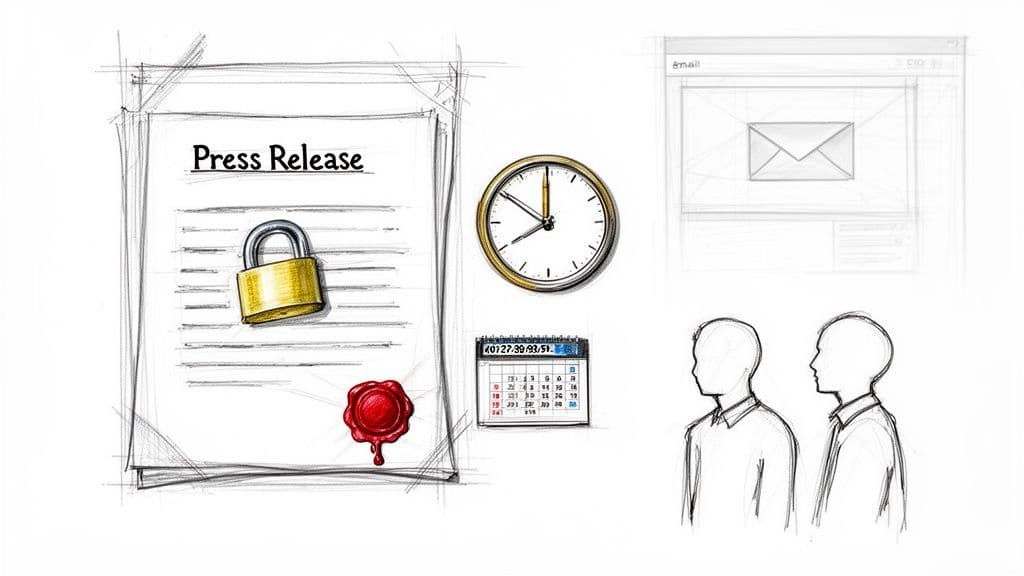
Ever wondered how big companies seem to get dozens of articles published about their new product all at the same time? The secret is often a well-orchestrated press release embargo.
Think of it as a strategic agreement between you and the media. You give journalists your news before you officially announce it, and they agree not to publish anything until a specific date and time. This simple "gentlemen's agreement" gives reporters a crucial head start to research, conduct interviews, and write a much more thoughtful story.
When your announcement finally goes live, you don't just get a trickle of mentions—you get a wave of in-depth coverage, all hitting at once for maximum media impact.
Understanding the Press Release Embargo
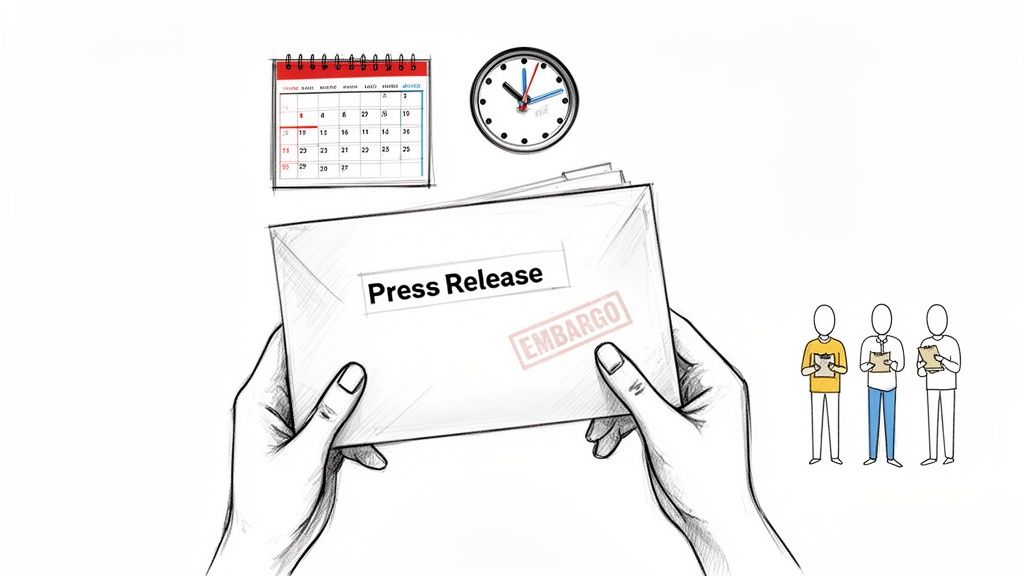
At its core, an embargo is about giving journalists the one thing they rarely have: time. Instead of frantically trying to cover breaking news, they have the space to do their job properly.
For a startup founder launching a new product, this can mean the difference between a quick blurb and a full feature story. By coordinating a media splash, you ensure multiple outlets are talking about your big news simultaneously, completely dominating the conversation on launch day.
Why It's So Effective
Journalists are constantly up against tight deadlines. An embargoed press release removes that immediate pressure, allowing them to dig deeper.
With that extra time, they can:
- Do their homework and properly fact-check all the details.
- Line up interviews with your CEO, investors, or key partners.
- Get outside opinions from industry analysts or other experts.
- Write a truly compelling story, not just a rewrite of your press release.
This isn't just a startup tactic. Major government bodies like the U.S. Census Bureau regularly use embargoes to give qualified media early access to important economic data. It prevents a mad dash to publish unverified numbers and ensures everyone is working from the same accurate information. You can learn more about how government agencies use press embargoes on Census.gov.
Embargo vs Exclusive vs General Release
It's easy to mix up embargoes and exclusives, but they serve very different strategic purposes. An exclusive means you give your story to just one high-profile outlet, hoping for a single, powerful feature. An embargo, on the other hand, involves sending the news to many journalists at once for a coordinated, widespread release.
Let's break down the key differences to help you decide which approach is right for your announcement.
| Strategy | What It Is | Best For | Potential Outcome |
|---|---|---|---|
| Embargo | Distributing news to multiple journalists under the condition they don't publish until a set time. | Major product launches, funding announcements, significant company milestones. | Widespread, simultaneous media coverage that dominates the news cycle on a specific day. |
| Exclusive | Giving the story to a single, high-value media outlet before anyone else. | Highly compelling, human-interest stories or when you want to target a specific, influential audience. | One in-depth, high-impact feature in a top-tier publication. |
| General Release | Sending a press release to a broad list of media contacts for immediate publication. | Routine company news, minor updates, or announcements that aren't time-sensitive. | A smaller, scattered number of pickups as journalists have time to cover it. |
Ultimately, the choice comes down to your goals. If you're aiming for a single, blockbuster story in a dream publication like The Wall Street Journal, an exclusive might be your best bet. But if you want to make a massive splash and get everyone talking on the same day, embargoing your press release is the way to go.
Deciding When an Embargo Makes Sense
An embargo is one of the most powerful tools in your PR kit, but like any specialized tool, it's not for every job. If you start slapping an embargo on every minor company update, you’ll quickly find your emails getting ignored.
The real power of an embargo comes from using it sparingly. Its purpose is to give journalists a head start on a story that’s complex, data-heavy, or has a lot of moving parts. Ask yourself: does a reporter need extra time to truly understand and do this story justice? If the answer is a clear yes, you’ve got a good case for an embargo.
When to Embargo Your Press Release
So, what kind of news actually fits the bill? Certain announcements are practically begging for the embargo treatment. These are the stories that benefit from thoughtful, in-depth reporting that simply can't be rushed.
Think about using an embargo for these high-impact scenarios:
- A Major Funding Round: Announcing your Series A or a later round isn't just about the dollar amount. An embargo gives a reporter the runway to interview your lead investors, dig into your market position, and write a piece with genuine substance.
- A Complex Product Launch: Is your new product a big technical leap or packed with intricate features? Reporters need time to really get it. Giving them embargoed access to demos, white papers, and your engineers is how you get a rich, detailed story instead of a superficial mention.
- Groundbreaking Research or Data: If you're dropping a proprietary study with surprising stats, an embargo is your best friend. It lets journalists actually read the report, talk to outside experts for their take, and present your findings with the context they need.
- A Strategic Partnership or Acquisition: These deals are never simple. An embargo gives reporters time to speak with leaders from both companies, understand the long-term strategy, and tell the full story behind the handshake.
This kind of coordination is standard practice in high-stakes fields. Major scientific conferences, for instance, often embargo all research abstracts until a specific date and time. This ensures complex health news is reported accurately and simultaneously worldwide. A great example is the strict media policy for the American Society of Hematology's annual meeting.
When to Skip the Embargo
Knowing when not to use an embargo is just as crucial as knowing when to use one. Every time you send a routine announcement under embargo, you chip away at its power. Save it for the big moments.
It’s almost always better to skip the embargo for routine news, like:
- Minor company updates
- New hires (unless it’s a seismic C-suite shift at a public company)
- Winning a small industry award
- News that’s simple and easily understood in a few seconds
For this kind of stuff, a standard press release sent for immediate distribution is the way to go. It’s a sign of respect for a journalist’s time and it trains them to know that when you do send an embargoed pitch, it’s because you’ve got something genuinely important to share.
7. How to Send an Embargoed Press Release
So you've decided an embargo is the right strategic play for your announcement. What now? The next steps are all about precision and careful execution. Sending an embargoed press release is more than just slapping a note on an email—it’s about building trust and ensuring absolute clarity from the get-go.
Your most important tool here is the embargo notice. This is no time to be subtle. The notice has to be completely unmissable, sitting right at the top of your press release and featured prominently in your email’s subject line and body.
Nailing the Embargo Notice
Vagueness is your worst enemy. A casual note like "Embargoed until Tuesday" is just asking for trouble. You have to be ruthlessly specific, especially when dealing with journalists across different time zones.
Here’s a format that leaves no room for error:
- EMBARGOED: NOT FOR RELEASE UNTIL 9:00 AM ET ON TUESDAY, OCTOBER 28, 2025
Always spell out the date, the exact time, and the time zone (ET, PT, GMT, you name it). This simple line of text prevents the single most common reason embargoes get broken by accident. Make sure it’s in bold, all-caps, and placed at the very top of your press release document, even above the headline.
This flowchart maps out the thinking process for deciding if your news actually needs this kind of coordinated effort.
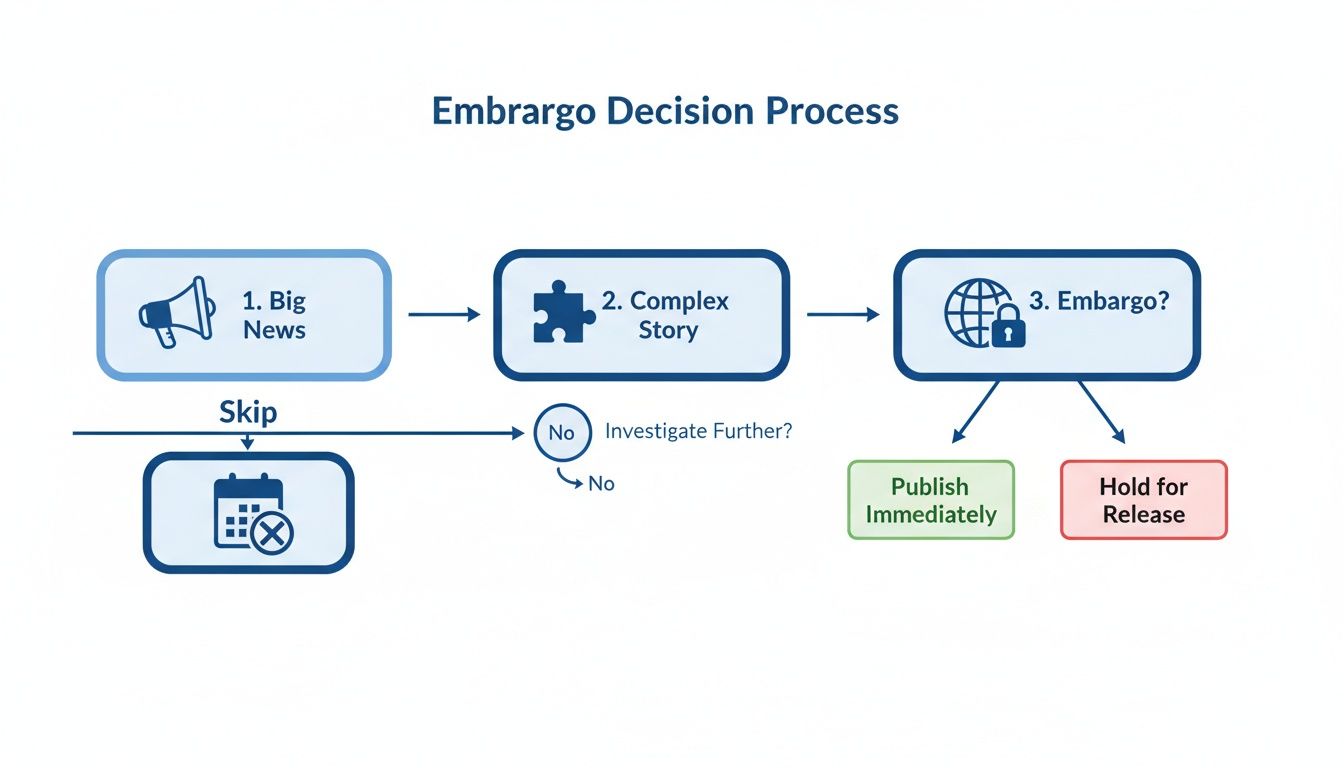
As you can see, embargoes are really meant for big, complex stories that need time to unpack. Simpler news? Just stick to a standard release.
Getting Agreement Before You Send a Thing
Here's a pro tip: never, ever attach an embargoed press release to a cold email. That's a rookie mistake. Your first move should always be to pitch the story concept and get the journalist's explicit agreement to honor the embargo. You're asking for their trust, so you need to lead with it.
Your initial outreach should:
- Quickly introduce the story and why it's a good fit for them.
- Clearly state the information is under embargo until a specific date and time.
- Directly ask if they agree to the terms before you send any materials.
A quick "Yes, I agree to the embargo" in a reply email is your green light. This simple confirmation turns a hopeful pitch into a professional handshake, dramatically cutting down your risk of leaks.
With thousands of press releases flying around every day, this professional approach makes your pitch stand out. For businesses that send ten or more releases a year, a well-executed embargo strategy can deliver a 100-175% ROI within 90 days. And since 74% of reporters still prefer getting news via press releases, respecting their process is just good business.
Once you have that agreement, you’re clear to send the full press release and any supporting assets. This two-step process shows you respect the journalist's time and sets a professional foundation for your relationship. For a full breakdown of the nuts and bolts, check out our guide on how to send a media release.
Managing Follow-Ups and Handling Embargo Breaks
Once your embargoed press release is out the door, the real work begins. This next phase is a delicate dance of following up respectfully and keeping a close eye on everything. Your goal is to keep your story on a journalist's radar without becoming that person they dread seeing in their inbox.
A thoughtful follow-up isn't just a poke; it's a tool. It reminds them you're on top of things and ready to help them build a richer story. Offering up an exclusive chat with your CEO or a hands-on demo can be the very thing that moves your news from their "maybe" pile to their "must-cover" list.
The Art of the Gentle Nudge
Your follow-up game should be simple, genuinely helpful, and most importantly, not annoying. I’ve found a light touch works best. You're not chasing them; you're offering assistance.
Think about a rhythm that respects their time:
- Initial Check-in: About 24 hours after you send the release, a quick, polite email to make sure they got everything and ask if any questions have popped up.
- Offer More Value: A few days later, or about midway through the embargo period, send another note. This time, come with a specific offer—an interview, extra data, or a product walkthrough. This isn't a "just checking in" email; it's a value-add.
- The Final Reminder: The day before the embargo lifts, a short and sweet reminder is all you need. Something like, "Just a friendly heads-up that our news embargo lifts tomorrow at 9:00 AM ET."
This approach shows you're professional and organized, not desperate.
At its heart, an embargo is a professional agreement built on trust. How you communicate during this waiting period either strengthens that trust or erodes it, setting the tone for every interaction you'll have with that journalist in the future.
When an Embargo Breaks: Your Action Plan
It happens. Despite all your careful planning, someone might jump the gun. A journalist could get the time zone wrong, or a glitch in their CMS could push an article live too early. The absolute key is not to panic. Your calm, professional response is what will protect your relationships.
If you spot a breach, take a deep breath and move fast.
- Confirm It's Real: First things first, make absolutely sure the embargo was broken. Double-check the publication, the time, and the date against the terms you sent. Was it an honest mistake or a real breach?
- Contact the Source Directly: Get in touch with the journalist and their editor immediately. Your tone here is crucial—assume it was an accident, not a malicious act. Calmly explain what happened and politely ask them to pull the story down until the official time.
- Alert Everyone Else: This is non-negotiable. You have an ethical obligation to immediately email every single journalist who honored the embargo. Let them know a breach has occurred. While you can ask them to stick to the original time, fairness dictates you inform them that the news is now public. This single action preserves your integrity and shows you respect their professionalism.
To really nail the delicate process of an embargo and minimize the risk of breaks, it’s smart to build your outreach into a comprehensive stakeholders communication plan. For more nitty-gritty advice on building these vital media relationships from the ground up, check out our guide on how to contact journalists.
Turning a potential disaster into a masterclass in professionalism is what separates the pros from the amateurs.
Managing this whole process requires a clear, repeatable workflow. Here’s a simple checklist to keep you on track from the moment you hit "send" to the final follow-up.
The Embargo Outreach Workflow
| Timeline | Action | Key Objective |
|---|---|---|
| Day 1 | Send embargoed press release | Distribute materials securely to your targeted media list. |
| Day 2 | Send initial confirmation email | Confirm receipt and offer initial assistance for questions. |
| Mid-Embargo | Offer exclusive value (interview, demo) | Re-engage interest and provide unique story angles. |
| 24h Before Lift | Send final reminder email | Ensure all journalists have the correct lift time and date. |
| Embargo Lift | Monitor for coverage | Track who publishes and when. |
| Post-Lift | Amplify published stories | Share coverage on social media, tagging journalists. |
| Post-Lift | Send personalized thank-you notes | Strengthen relationships with journalists who covered your story. |
This structured approach ensures no step is missed and that every journalist feels respected throughout the process, even when things go wrong.
Using Automation for Smarter Embargo Outreach
Let’s be honest: manually managing an embargoed press release is a founder’s nightmare. You’re trying to build targeted lists, write personal pitches, secure embargo agreements, and then chase down every single journalist. It’s not just a time sink; it’s an open invitation for something to go wrong.
This is exactly where PR tech comes in. It turns that chaotic, high-stakes process into something predictable and scalable. Think of it as an AI-powered partner that handles the grunt work—finding the right journalists in your niche, sending out personalized pitches that clearly outline the embargo, and even managing the follow-ups so you stay on their radar without being annoying.
Streamlining the Entire Workflow
The real magic of using a platform is pulling your entire embargo outreach into one place. Forget about wrestling with spreadsheets, scattered email threads, and a mess of calendar reminders. A dedicated tool centralizes everything.
This does more than just save you a ton of time. It dramatically cuts down the risk of human error, like sending the full press release before a journalist has actually agreed to the embargo. For anyone looking to get a leg up, exploring the best AI marketing automation tools can be a huge advantage.
Here’s a look at how a platform like PressBeat can organize every step, from finding the right contacts all the way to tracking your published stories.

The point is that every stage is connected. It creates a smooth, logical flow that takes the manual guesswork out of the equation.
Gaining Real-Time Transparency
One of the worst parts of embargo outreach is the waiting and wondering. Did the reporter agree to the terms? Did they even open the press kit? Are they actually writing a story? Good automation gets rid of the guesswork and gives you a real-time dashboard with complete transparency.
You can see the most important metrics at a glance:
- Pitch Deliveries: Instantly confirm your email landed in their inbox.
- Open and Click Rates: See which journalists are showing early interest.
- Embargo Agreements: Get a clear list of who has officially agreed to your terms.
- Journalist Replies: Keep all of your back-and-forth conversations in one organized spot.
This kind of insight is a total game-changer. Instead of just crossing your fingers, you have hard data telling you where to focus your energy. You can double down on the reporters who are genuinely engaged and most likely to give you coverage.
This data-driven approach turns embargo outreach from a shot in the dark into a measurable strategy. By automating the tedious tasks, you get your time back to do what actually matters: building real relationships with the people who will tell your story.
If you’re curious how different platforms compare, you can learn more about the leading PR automation tools in our detailed comparison. At the end of the day, the right tech makes even the most complex embargo plan manageable, repeatable, and a whole lot more effective.
Common Questions About Press Release Embargoes
Embargoes can feel like a high-wire act, especially when a major announcement is on the line. I get a lot of questions from founders and even seasoned PR pros about the finer points. Let's walk through some of the most common ones so you can use this strategy with confidence.
How Far in Advance Should I Send an Embargoed Press Release?
This is a classic "it depends" question, but the answer really hinges on the complexity of your news.
For a big, meaty announcement—think a Series B funding round or a complex new product launch—you'll want to give top-tier national reporters at least 3-5 business days. This isn't just courtesy; it's practical. It gives them enough runway to schedule interviews with your CEO, get quotes from analysts, and actually write a story that does your news justice.
But if the news is more straightforward, like a new partnership or a feature update, and you're targeting niche trade publications, 24-48 hours is often plenty of time. The key is to find that perfect balance: enough time for them to do a good job, but not so much that your pitch gets buried under a week's worth of other emails.
What Happens if a Journalist Refuses to Honor the Embargo?
This one is simpler than it sounds. An embargo is a handshake agreement, a pact built on mutual trust. It's not a legal contract.
If you pitch a reporter and they explicitly say they won't honor the embargo, your next move is easy: don't send them the press release. Just thank them for their honesty and move on. You haven't lost anything because they never had the information in the first place.
An embargo is a two-way street. If a journalist doesn't agree to the terms before you give them the sensitive info, there is no agreement. It's far better to walk away from one potential story than to risk a leak that torpedoes your entire launch.
Now, if a journalist agrees to the embargo and then publishes early anyway, that’s a different story. It’s a serious breach of professional ethics, and while it’s rare, it happens. In this case, you’d immediately jump into your embargo break plan: call the editor, inform your other media contacts, and make a note to never work with that reporter again.
Can I Embargo News That Is Already Public?
No. Full stop.
This is one of the cardinal rules of media relations. An embargo is exclusively for information that is 100% confidential.
If even a whiff of your news is out there—on a subreddit, a team member's social media, a foreign-language blog—it's public. Trying to put an embargo on information that's already in the wild is a rookie mistake that will get you laughed out of a reporter's inbox and instantly destroy your credibility. Always do a deep search to make sure your secret is still a secret before even thinking about an embargo.
Should I Use an Embargo or an Exclusive?
Choosing between an embargo and an exclusive comes down to your strategic goal. Are you trying to make a big splash or land a deep, meaningful story?
Go with an Exclusive if… you want a deep, thoughtful feature in a top-tier publication. You're giving the story to one journalist, letting them own it. This is great for building a strong relationship with a key reporter and getting a nuanced, high-impact article.
Go with an Embargo if… you want to create a massive, coordinated media moment. By letting multiple outlets publish at the exact same time, you generate a wave of coverage that makes your announcement feel like a major industry event.
Think of it this way: an exclusive is a sniper rifle, aiming for one perfect shot. An embargo is a shotgun, designed for maximum spread and impact on launch day.
Ready to manage your next big announcement without the manual chaos? PressBeat uses AI to identify the perfect journalists, send personalized embargoed pitches, and track your results in real-time. Get predictable media coverage today.