
A Modern Playbook for PR for Startups
February 1, 2026
PR is your secret weapon for building credibility from scratch. It’s how you take your story—your unique vision, your groundbreaking data, your founder's journey—and turn it into earned media that grabs the attention of investors, customers, and top talent. Think of it as a strategic process for proving you belong. This playbook will walk you through building a modern, nimble PR engine that actually drives results.
Why Traditional PR Agencies Don't Work for Startups
For most founders, the phrase "PR agency" conjures up images of eye-watering retainers, vague promises, and a process completely detached from the chaotic reality of building a startup. The old-school PR model was built for a different world, one where massive corporations could afford to play the long game. That just doesn't fly when you need to show traction now.
It's a story I've heard countless times. A startup signs a five-figure monthly contract, and in return, they get a long list of "potential" journalist targets and a couple of generic press release drafts. Communication is painfully slow, and success is measured in fuzzy metrics like "impressions" instead of things that actually move the needle, like qualified leads or investor calls.
The Broken Old-School Playbook
At its core, the problem is a total misalignment of incentives. Traditional agencies often bill by the hour, which means their profit is tied to the time they spend, not the results they deliver. The process itself becomes the product, leaving you holding the bag and wondering what, exactly, you paid for.
Here are the classic pain points that should sound familiar:
- Insane Costs: High monthly retainers are a non-starter for early-stage companies trying to manage their burn rate.
- Glacial Pace: The endless layers of approvals and manual outreach just can't keep up with a startup that ships code multiple times a day.
- No Guarantees: You can easily spend tens of thousands of dollars and get absolutely zero meaningful coverage in return. Most agencies guarantee nothing.
- Smoke-and-Mirrors Reporting: You'll get reports filled with vanity metrics like "media impressions" instead of hard data like referral traffic, valuable backlinks, or demo sign-ups.
Let's be honest: getting press coverage is getting harder. The global PR market is set to hit $112.98 billion in 2025, yet the average journalist responds to a dismal 3.43% of pitches.
That incredibly low success rate is precisely why the old spray-and-pray approach is a recipe for failure. Startups can't afford to burn cash on a gamble. If you want to dive deeper into these stats, prlab.co offers some great industry benchmarks.
A Modern, Agile Approach to PR
So, what's the alternative? Instead of outsourcing your story and just hoping for the best, you need to treat PR as a core growth function—something you manage with the same discipline you apply to product development or your sales funnel.
This modern approach is all about building direct relationships with journalists, using smart technology to work efficiently, and measuring what actually matters to your business. It puts you in the driver's seat.
Let's quickly compare the two models.
Traditional PR Agency vs Modern PR Platform
| Attribute | Traditional PR Agency | Modern PR Platform (e.g., PressBeat) |
|---|---|---|
| Cost | $5,000 - $20,000+ monthly retainers | Flexible, often performance-based or a lower fixed fee |
| Transparency | Black box; little insight into outreach activities | Full visibility into pitches, open rates, and replies |
| Process | Manual, slow, and relationship-dependent | Tech-driven, automated, and data-informed |
| Outcomes | Vague "impressions" and "brand awareness" | Measurable: backlinks, referral traffic, leads, sign-ups |
| Guarantee | None. You pay for effort, not results. | Often ties payment to successful placements. |
The difference is night and day. A modern PR platform or a well-run in-house system gives you the control and transparency you need. You can see your outreach campaigns in real-time, track every open and reply, and directly connect media coverage to your business goals. This playbook is designed to help you build that smarter, more effective PR machine right from the start.
Finding Your Story and Building a Lean Media Kit
So, where does good PR actually start? It’s not with the pitch. It’s not even with your media list. It begins with a story—one that’s genuinely interesting and connects to something bigger than your product.
Let's be blunt: a journalist doesn't care about your launch just because you're excited about it. They're on the hunt for a narrative that will grab their readers. They need to know the why—why does this matter, who does it help, and what does it change?
Your launch is just one moment in time. Your real stories are much deeper.
Uncovering Your Newsworthy Angles
The best PR campaigns I've ever seen were built on great stories, not just announcements. You have to learn to see your startup through a reporter's eyes. This means shifting your thinking from "here's what we built" to "here's what this means for the world."
Every startup, even a brand new one, is sitting on a goldmine of potential angles. You just need to know where to look.
Here are a few classic narratives that always get a journalist's attention:
- The David vs. Goliath Story: Are you the scrappy innovator taking on a stale, old industry giant? This is a story as old as time, and readers (and reporters) love to root for the underdog. It’s a powerful frame.
- The Unique Data Story: Do you have access to data nobody else has? Maybe your fintech app reveals a wild new Gen Z spending trend, or your SaaS tool uncovers a counterintuitive productivity hack for remote teams. Original data is PR gold.
- The Founder's Journey: Was your company born from a deeply personal struggle or a sudden, brilliant insight? An authentic, human-centric founder story can forge an immediate emotional connection and make your company far more memorable.
- The Counter-Narrative Story: Is the rest of your industry zigging? Find a compelling, evidence-backed reason to zag. If everyone believes X, but you can prove Y is the future, you’ve just positioned yourself as a bold thought leader.
This isn't just about yelling into the void; it's about finding the right story to earn people's attention. PR has changed dramatically, moving away from just buying ads and toward building real influence.
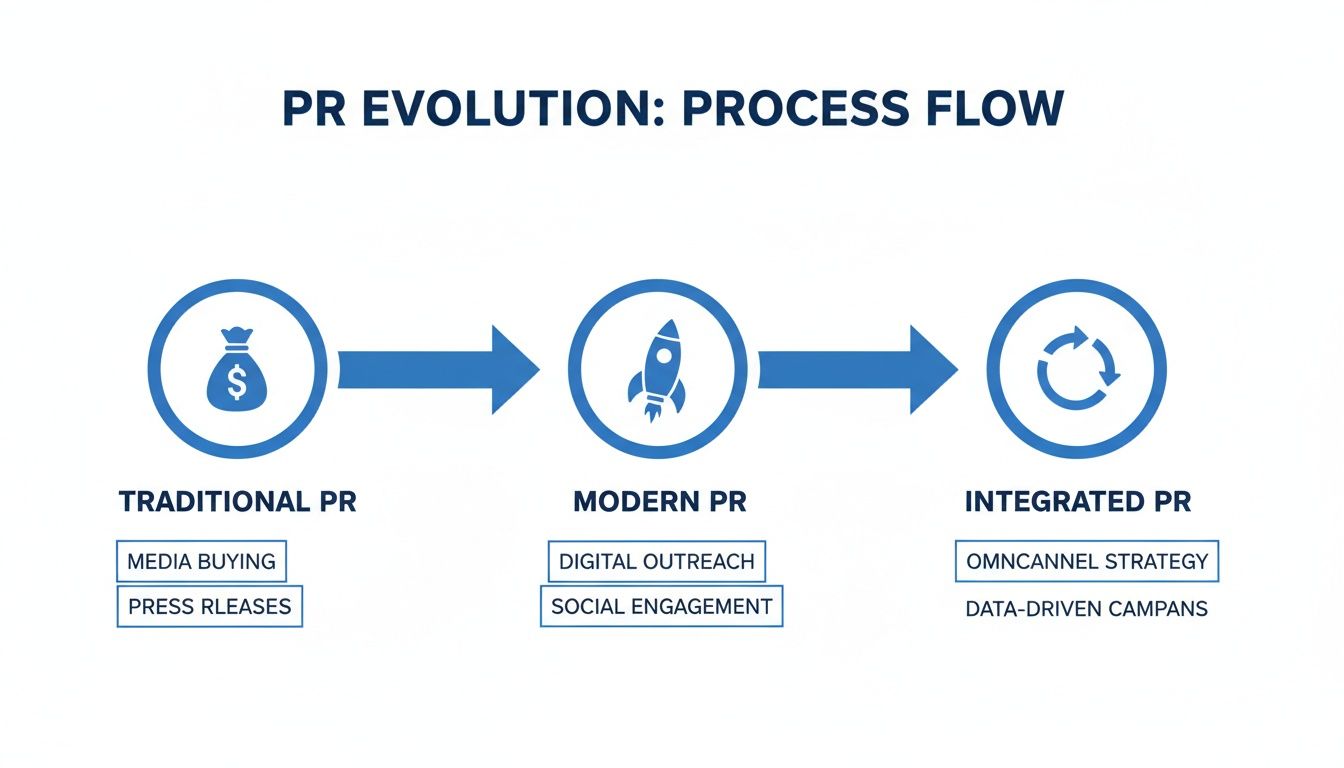
The game has shifted from transactional announcements to strategic storytelling. This is the single most important concept for a startup to grasp.
Assembling a Reporter-Friendly Media Kit
Once you've nailed down a few strong angles, your next job is to make a journalist's life ridiculously easy. The best way to do that is with a lean, digital-first media kit.
Forget about sending clunky ZIP files or a dozen separate attachments. Your goal is to give a reporter everything they need in one click, saving them time and making you look like a pro.
A great media kit anticipates a journalist's needs. It should answer their basic questions instantly and provide high-quality assets they can use immediately, reducing the friction between their interest and a published story.
Your media kit should be a simple, shareable link—a Google Drive folder is perfect, or a dedicated page on your website works well too. It's not a sales deck; it’s a resource hub. When a reporter is staring down a 5 p.m. deadline, having this ready to go can be the difference between getting the feature and getting ignored.
For a deeper dive, our guide on how to create a press kit has everything you need.
Here’s a checklist of the absolute essentials for your lean kit:
- Company Fact Sheet: A clean, one-page PDF is all you need. Include your founding date, founder names and titles, total funding, a few key stats, and your concise company boilerplate. Think of it as your company's cheat sheet.
- High-Resolution Logos: Don’t make them hunt for it. Provide your logo in multiple formats (a PNG with a transparent background is a must) and colors (full color, all-black, all-white).
- Founder Headshots: Professional, high-res photos are non-negotiable. Give them a few options to choose from—maybe a more formal shot and a candid one.
- Product Screenshots & B-Roll: For software, have a folder of clean, high-quality UI shots ready. For a physical product, get professional photos from several angles. If you have it, a few short, silent video clips (B-roll) will make you a video editor’s best friend.
- Past Press Mentions: Create a simple doc with links to your best 3-5 pieces of coverage. This acts as social proof and shows reporters how your story has been told before.
By packaging your story and your assets together this way, you’re not just pitching an idea—you’re delivering a story kit. It shows you understand and respect a journalist's process, which instantly sets you apart and massively improves your odds.
Building a Hyper-Targeted Media List
Spraying and praying with a generic pitch is the fastest way to get your email deleted and your startup blacklisted. Let’s be clear: success in PR isn't about volume; it's about precision. Your real goal is to build a curated list of advocates who speak directly to your ideal customers, not just a giant spreadsheet of names.
This targeted approach has never been more important. With business applications jumping 60% since 2020 to a staggering 430,000 per month, the market is completely flooded. Good PR is what helps you rise above that noise. Globally, 1,245 startups have hit billion-dollar status, and for the 95 VC-backed firms that went public in 2020, smart media visibility was a huge part of their journey. You can dig into more of these startup trends on explodingtopics.com.
Identifying Your Ideal Journalist Persona
Before you even think about names, you need to define who you're looking for. Just like you have an ideal customer profile, you need an ideal journalist persona. This simple step saves you from wasting hours chasing the wrong people.
Forget just targeting big names at major tech publications. Think about the specific "beat" that actually aligns with your story. Your perfect contact might be a niche blogger with a small but fiercely loyal audience of software developers, or a newsletter author whose subscribers are all VPs of marketing.
Think through these factors for your persona:
- Publication Tier: Are you shooting for the stars with a national outlet (Tier 1), aiming for a respected industry journal (Tier 2), or targeting a niche blog with a super-engaged community (Tier 3)? All of them have their place.
- Audience: Who actually reads their stuff? Does their audience profile look a lot like your target customer? A feature in a publication read by your buyers is worth ten times more than a generic mention somewhere else.
- Beat Relevance: Does this person live and breathe topics like "B2B SaaS pricing" or "sustainable supply chains"? The more specific, the better.
- Article Style: Do they write deep, data-driven analyses? Founder interviews? Quick-hit product reviews? Your pitch needs to match the kind of content they already produce.
Vetting Contacts Beyond the Bio
Okay, you’ve got a list of potential names. Now the real work starts. A journalist's title and bio only tell you half the story. You have to dig deeper to make sure they're a perfect fit before you ever hit "send."
This vetting process is what separates the pros from the amateurs. It’s manual, yes, but it’s the secret sauce that makes sure every email you send has the highest possible chance of landing.
Don't just look at what a journalist covers; look at how they cover it. Pay attention to the tone, the depth of their articles, and the types of sources they quote. This is the insight that helps you craft a pitch that feels like it was made just for them.
Take ten minutes and read their last three to five articles. Do they actually seem interested in the topics? Do they feature startups at your stage, or do they only cover the established giants? A quick scan of their Twitter or LinkedIn feed can also give you clues about their current interests and what they might be working on right now.
For a deeper dive into building out your list, our guide on media contact databases has more strategies and tools to check out.
Prioritizing Your Outreach Efforts
Even after vetting, your list could have dozens of names. To keep from getting overwhelmed, you need a simple prioritization system. A tiered approach helps you focus your A-game where it will have the biggest impact.
Try organizing your contacts into three buckets:
- Tier 1 (The Dream List): These are your top 5-10 journalists. They’re at high-impact publications and are a perfect match for your story. Your outreach to them needs to be deeply personal and meticulously researched. No templates here.
- Tier 2 (The Strong Fits): This group is probably 15-20 reporters and bloggers at key trade publications or influential niche sites. Personalization is still crucial, but you can start to work a bit more efficiently.
- Tier 3 (The Broader Net): These are other relevant contacts who are good, but not perfect, fits. Your outreach here can start from a solid template, but you still need to customize it with their name, publication, and a relevant detail.
This method turns a massive, intimidating task into a manageable workflow. It ensures your very best pitches are saved for your very best prospects.
Writing a Pitch That Actually Gets a Reply
Let’s be honest: a journalist’s inbox is a war zone. Hundreds of emails a day, all screaming for attention. Your pitch needs to be less like another shouting voice and more like a helpful, well-timed whisper that cuts right through the noise.
A great pitch isn’t about marketing fluff or buzzwords. It’s about respect. It shows you’ve done your homework, you understand the journalist’s work, and you have a story that will genuinely interest their readers.
Crafting a Subject Line That Cuts Through the Clutter
Your subject line is your first—and maybe only—impression. If it’s boring, generic, or sounds like spam, your email is dead on arrival. The goal is to be specific and intriguing, not clickbaity.
Forget lazy subject lines like "Story Idea" or "For Immediate Release." Get straight to the hook.
- For a Data Story: "New Data: Remote Startups Outperform Office-Based Counterparts by 15%"
- For Expert Commentary: "Following the [Competitor] News, a Counterintuitive Take on Market Consolidation"
- For a Product Launch: "Pitch: A New AI Tool That Automates Content Moderation for Online Communities"
Each of these tells the reporter exactly what they're getting. It respects their time and lets them triage your email in seconds, which is the first step to actually getting it read.
The Anatomy of a Personalized Pitch
Once they've opened your email, you have about ten seconds to make your case. Keep it brutally short—under 150 words is the sweet spot. Anything longer feels like homework, and busy journalists don't have time for that.
Think of your pitch in four simple parts:
- The Genuine Opener: Show you're a real human who actually reads their stuff. Don't just say, "I loved your recent article." Get specific. "Your piece on last-mile delivery logistics really hit home, especially your point about urban warehousing." That one sentence proves you’re not just blasting a list.
- The Core Pitch: Jump right in. In one or two sentences, what’s the story and why should their audience care? Tie it directly to their beat.
- The "Why You?" Hook: Briefly explain what makes you or your startup the authority here. Is it a surprising data point? A unique founder story? A major milestone you just hit?
- The Easy "Yes": End with a clear, low-friction ask. "Happy to send over the full data report if you're interested," or "Are you free for a quick 10-minute chat next week?" are perfect.
For startups pitching new or complex ideas, this clarity is everything. If you're looking for a deeper dive into crafting your message, the Buzzy Rocket Startup Pitch Package is a fantastic resource.
The golden rule of pitching is to make it about them, not you. Your news should be framed as a story that serves their audience, solves a problem for them, or gives them a unique angle on a trending topic.
The Art of the Polite Nudge
No reply doesn't always mean no. More often, it just means "buried." Journalists are swamped, and even good pitches get lost in the shuffle. A polite follow-up is a non-negotiable part of any startup’s PR game.
Give it 5-7 business days. Then, reply directly to your original email so they have the context. Never, ever send a passive-aggressive "just checking in" or "bumping this up" email. Instead, add a little something new to sweeten the deal—a fresh data point, a quick customer quote, or a link to a new industry trend that makes your story even more relevant.
This targeted approach isn't just for traditional media anymore. For startups, influencer PR can be a massive growth lever. With 64% of 2025 campaigns expected to feature creators, the impact is 2x faster than old-school methods and delivers an incredible 18x ROI over paid ads. Your pitch needs to be just as sharp for a YouTuber with a dedicated audience as it is for a reporter at a major tech publication.
Managing Outreach and Building Media Relationships
Alright, you've got your story locked down and your pitch is sharp. Now for the real work: getting it in front of the right people. This is where most startups stumble, quickly finding themselves buried in a messy spreadsheet of contacts, follow-up dates, and missed opportunities.
The trick isn't just to send a bunch of emails. It's about building a system—a simple, repeatable process—to manage your outreach pipeline. This turns every pitch, every response, and every rejection into a long-term asset.
You don't need fancy, expensive software to get started. A simple Trello board or an Airtable base can be your command center. Create columns for "To Pitch," "Pitched," "Following Up," "In Conversation," and "Coverage Secured."
This simple structure instantly brings order to the chaos. It helps you avoid embarrassing mistakes, like pitching the same journalist twice or, even worse, forgetting to follow up on a warm lead who actually showed interest. It turns your outreach from a random flurry of activity into a predictable workflow.
Turning Cold Outreach Into Warm Relationships
Let's be clear: the ultimate goal of startup PR isn't just one article. It's building a network of journalists who know you, trust you, and will cover you for years to come. That means every single interaction is a chance to build genuine rapport.
When you get a positive reply, you're officially on the clock. Your response time and professionalism here can make or break the opportunity.
- Be ridiculously fast. Journalists work on insane deadlines. When they say yes, they needed your info yesterday. Aim to reply within the hour, if not sooner.
- Make their job easy. Immediately confirm an interview time and send a calendar invite. Have your media kit link ready to paste in. Don't make them chase you for headshots or company stats.
- Clarify everything. Acknowledge their specific request so they know you’ve read their email carefully.
Even a "no" is an opportunity. A polite, professional response to a rejection can leave a lasting positive impression. Thank them for their time, acknowledge that the timing or fit wasn't right, and tell them you'll only reach out again when you have news that's a perfect match for their beat.
The single most powerful PR asset you can build is a small group of journalists who genuinely trust you. You build that network one respectful, helpful, and professional interaction at a time. It’s a long game, but it’s the only one worth playing.
This mindset shift—from just pitching stories to building relationships—is what separates startups that get a single mention from those that build real, lasting media momentum.
From First Contact To Published Story
Once a journalist expresses interest, your job shifts from pitcher to facilitator. You need to guide the process smoothly from that initial conversation all the way to a published piece.
This is where preparation pays off. A reporter might need a quick quote on a breaking industry trend, and if you can deliver a sharp, insightful comment within 30-60 minutes, you could easily land in a major publication.
Here’s a quick cheat sheet for handling the most common scenarios once you get a "yes."
| Scenario | Your Action Plan | Key to Success |
|---|---|---|
| Request for Quote | Provide a tight 2-3 sentence quote that directly answers their question. Include your name, title, and company. | Speed and relevance. Don't pitch your product; offer genuine insight. |
| Interview Scheduling | Immediately offer 3-4 specific time slots in their time zone and send a calendar invite the moment they confirm. | Flexibility. The easier you make it for them, the better. |
| Fact-Checking | Drop everything and respond. Be precise, clear, and correct any inaccuracies politely. | Accuracy. This is your last chance to get the details right before it goes live. |
| Post-Publication | Send a quick thank-you note. Share the article across your social channels and be sure to tag the journalist and their publication. | Amplification. Show them you value their work by helping it reach a wider audience. |
Handling this lifecycle like a pro doesn't just secure the story in front of you. It proves you're a credible, organized, and reliable source—making it far more likely that journalist will come back to you for their next story. That's how you build a powerful PR flywheel.
So, you landed a feature in a major publication. That's a huge win, right? Well, sort of. Popping that logo on your homepage feels great, but the real question is: what did it actually do for your startup? The true value of PR isn't just about bragging rights; it's about the tangible, measurable impact on your business goals.
We have to move past vanity metrics like social media shares to really prove the ROI of all that hard work. The best way to do this is by connecting press coverage directly to what matters most.
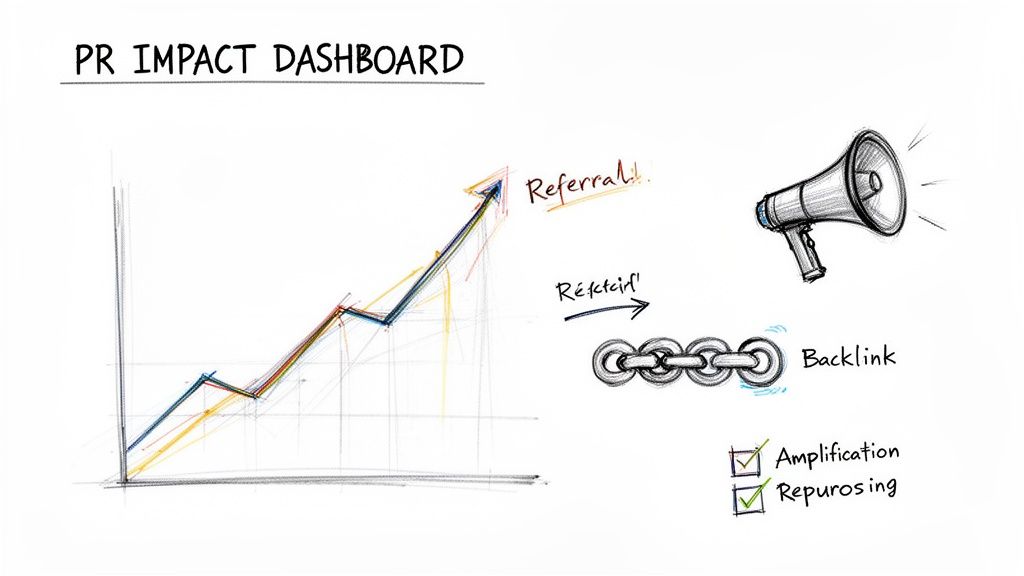
The most straightforward place to start is referral traffic. Always, and I mean always, use UTM parameters in any link you give a journalist. This little trick lets you hop into Google Analytics and see exactly how many people an article sent your way and what they did once they landed on your site. Did they sign up for a demo? Did they bounce immediately? This is where the story begins.
Beyond The Initial Traffic Spike
While a flood of new visitors is great, the ripple effects of good PR are often where the real gold is. Think about it: a high-authority backlink from a respected publication is a massive vote of confidence to search engines. That one link can seriously boost your SEO, helping people discover you organically long after the initial news cycle has moved on.
You also need to be tracking qualified leads. Did that feature in a niche industry journal lead to a sudden jump in demo requests from your perfect customers? When you can connect those dots in your CRM, you’re no longer talking about PR as a "nice-to-have." You're proving it's a powerful growth engine. For a deeper dive, check out our guide on the measurement of public relations.
Squeeze Every Ounce of Value from a Win
Getting the story published is only half the job. Now, you have to make sure everyone sees it. Don't just tweet the link once and call it a day.
A single piece of earned media is a powerful piece of social proof. Your job is to make sure every potential customer, investor, and employee sees it in multiple contexts.
Turn every mention into a long-lasting asset. Here’s a quick-and-dirty checklist to run through every single time you get a placement:
- Update Your Press Page: This is non-negotiable. Get the logo and a link to the article up on your site immediately.
- Create Social Content: Pull the best quotes and key takeaways. Turn them into graphics, short video clips, or text posts for LinkedIn, Twitter, and anywhere else your audience lives.
- Fire Up the Team: Drop the link in your company's Slack channel. It’s a huge morale booster and an easy way to get everyone to share it with their own networks.
- Power Up Your Sales Deck: Add the publication's logo to your sales materials. That third-party validation can be incredibly persuasive.
- Tell Your Investors: Good press is a sign of traction. Make sure it’s a highlight in your next investor update to build confidence.
- Boost Your Recruiting: Positive coverage makes you look like a great place to work. Add it to your careers page to attract top talent.
Your Burning Startup PR Questions, Answered
Let's be honest, when you're deep in the trenches of building a company, PR can feel like a whole other language. You've got questions, and I've heard them all. Here are the straight-up answers to the most common ones I get from founders.
How Much Should a Startup Realistically Budget for PR?
There's no magic number, but you've got a few paths. A traditional PR agency will want a retainer, typically starting around $5,000 and easily climbing past $20,000 per month. That's a serious chunk of your runway, often with no guarantee of results.
Going the DIY route costs you something just as valuable: your time. The sweet spot for most startups is using a modern PR platform. They offer a more predictable, performance-based model, which is exactly what you need when every dollar has to prove its worth.
When Is the Right Time to Start Thinking About PR?
Yesterday. Seriously, the best time to start is long before you feel ready for a big announcement. You should be crafting your story, defining your key messages, and putting together a simple media kit as soon as you have a clear vision for the company.
Then, you pull the trigger on active outreach campaigns when you hit a real milestone. Think about things like:
- A product launch or a game-changing update
- Closing a new round of funding
- Landing a big-name strategic partner
- Publishing a unique report with surprising data
The key is consistency. A slow, steady drumbeat of news is always better than one big, flashy press push that's forgotten a week later.
Are Press Release Newswires a Waste of Money?
For 99% of startups, yes. A hard yes. Newswires are expensive services that shotgun your announcement across a network of low-tier sites that real people rarely read. The return on that investment is almost always negative.
Don't light your money on fire. A single story, earned through a genuine connection with a journalist who writes for your target audience, is infinitely more valuable than 100 syndicated press release pickups. Focus on quality relationships, not quantity of links.
Ready to build credibility and get your story told by the right people? PressBeat uses AI to connect your startup with journalists at top-tier publications, guaranteeing media coverage that drives real growth. Learn more at https://pressbeat.io.