
Press Release Distribution Platform: Find the Best Fit for Your Goals
January 19, 2026
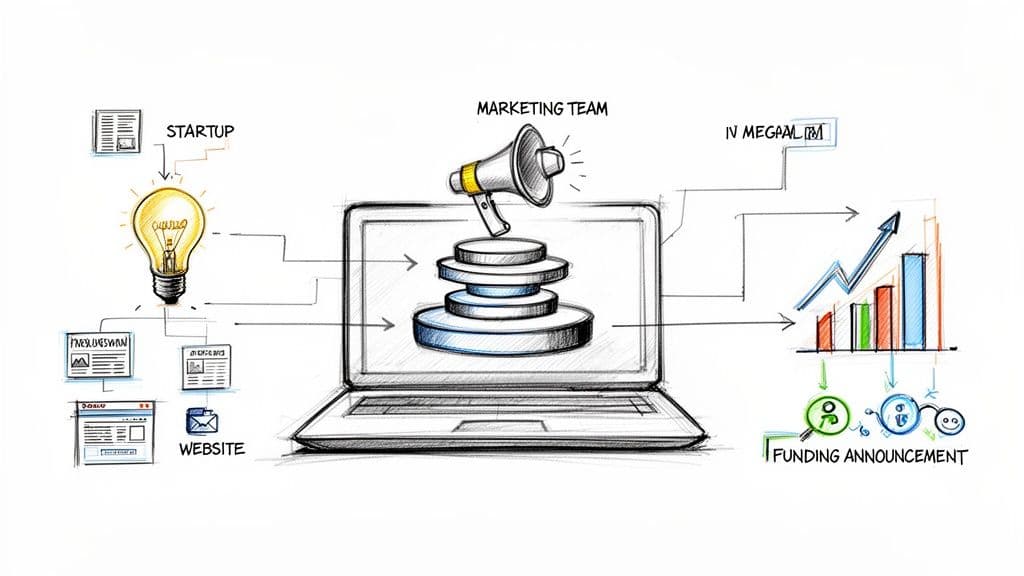
Think of a press release distribution platform as your direct line to journalists, media outlets, and online publications. These services take your news announcement and get it in front of the right people—the reporters and editors who can transform it into a story, giving you a serious boost in media coverage and online presence.
Understanding a Press Release Distribution Platform
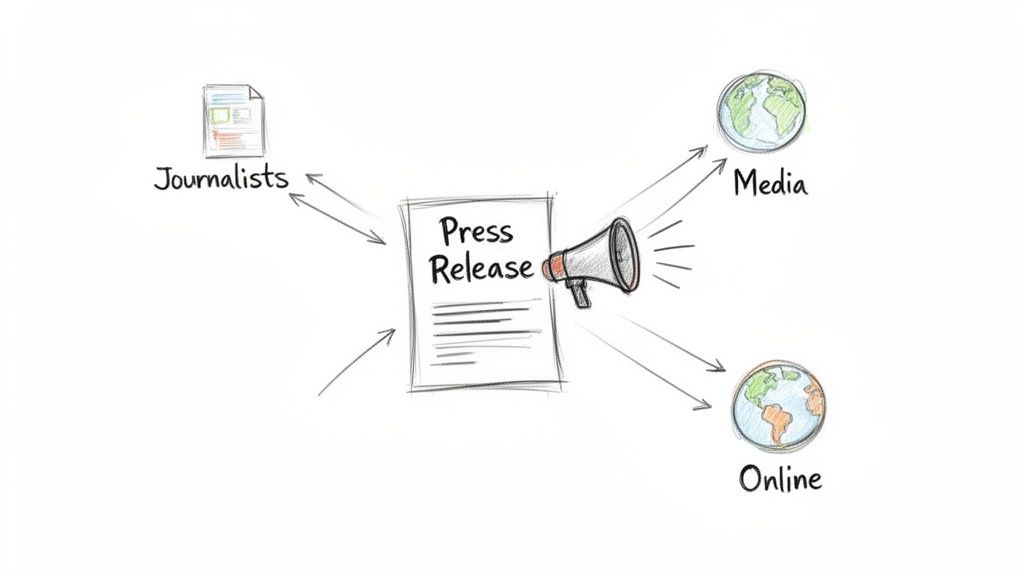
At its heart, a distribution platform cuts out the manual, often grueling, work of sending your news out. Forget about spending days building media lists and sending hundreds of personalized emails one by one. These platforms provide immediate access to their established networks of journalists, bloggers, and industry-specific publications.
The whole point is to get your message seen far beyond your own website or social media followers. By connecting with the right media contacts, you open the door to valuable earned media—that’s genuine coverage you don't pay for, unlike an ad. This kind of authentic exposure is gold for building credibility, especially if you're a startup or launching a new product. For a deeper dive into the mechanics, check out our guide on how to distribute a press release.
Core Functions and Platform Models
The press release services of today are a far cry from the old-school newswire model. Modern platforms offer a spectrum of services built for different goals, from blanketing the internet with your news to making highly targeted, personal introductions to specific journalists. Figuring out these different models is your first step to picking the right one.
Each type of platform serves a unique purpose. The traditional newswires are still the go-to for official corporate announcements that demand widespread, immediate syndication. On the other hand, self-service tools give you more control over targeting without breaking the bank. Then you have AI-powered platforms, which are all about building real relationships with journalists to secure high-quality, in-depth articles.
Key Takeaway: The best press release distribution platform isn't just a megaphone; it's a strategic tool. The right choice depends entirely on your goal—whether it's widespread syndication for an IPO or targeted earned media for a tech startup launch.
Comparing Press Release Platform Models
To make sense of the options, it helps to see how the main platform types stack up. Here’s a quick overview of the three primary models you'll encounter, outlining what they do best and who they're for.
Comparing Press Release Platform Models
| Platform Model | Primary Function | Best Suited For | Typical Pricing |
|---|---|---|---|
| Traditional Newswire | Mass syndication to wire services and newsrooms. | Public companies, major funding rounds, legal notices. | High per-release fees ($700+). |
| Self-Service Platform | Targeted distribution to specific industries or regions. | SMBs, product launches, event announcements. | Lower per-release or subscription fees ($200-$500). |
| AI Pitching Platform | Personalized outreach to secure earned media articles. | Tech startups, thought leadership, building brand credibility. | Monthly subscription with guarantees. |
As you can see, the right fit really comes down to your budget and, more importantly, what you're trying to achieve with your announcement. A major corporate filing has very different needs than a scrappy startup trying to get its first feature story.
The Evolving PR Landscape and Market Trends
The world of public relations has changed dramatically. Gone are the days of relying solely on manual outreach and personal contacts. Today, PR is all about data-driven strategy and automation, with businesses expecting to see real, measurable results from their campaigns. This shift is precisely why modern press release distribution platforms have become so essential—they're no longer just sending documents, they're engines for strategic amplification.
The market numbers back this up. The press release distribution software market, valued at USD 4.1 billion, is on track to hit USD 6.2 billion by 2031. That's a steady compound annual growth rate of 5.73%. This growth is being driven by companies, especially in tech, that need powerful tools to cut through the noise and get their stories heard. You can dig deeper into the market data in this comprehensive research report.
From Manual Outreach to Automated Pitching
Not long ago, a PR pro's greatest asset was their "little black book" of media contacts. Success meant spending countless hours researching journalists, writing individual emails, and then manually following up. It was a grind, and it was incredibly hard to scale. While building genuine relationships is still important, technology has brought a much-needed dose of efficiency to the process.
Modern platforms handle the most time-consuming parts of the job. They can find thousands of relevant journalists in minutes, sort them by their specific beats, and even manage entire outreach sequences automatically. This frees up PR professionals to do what they do best: focus on crafting a great story and building a solid strategy, not getting bogged down in administrative work.
The real value of a modern press release distribution platform isn't just speed—it's precision. Automation makes it possible to run highly targeted campaigns at a scale that was once unthinkable, putting the right story in front of the right journalist at the perfect moment.
This evolution is a direct result of the explosion in digital media. With an overwhelming number of blogs, online news outlets, and social channels, just getting a journalist's attention is half the battle. Automated systems help your pitch stand out by ensuring it's relevant, timely, and personalized.
The Impact of AI and Data Analytics
The latest leap forward is the integration of artificial intelligence and deep analytics. AI isn't just making outreach faster; it's making it smarter. Platforms powered by AI can analyze a journalist's entire body of work to understand their specific interests, preferred tone, and even the kinds of sources they like to quote.
This enables a new level of personalization that goes way beyond a simple "Hi [First Name]." Pitches can now be tailored automatically to align with a journalist's most recent articles, which significantly boosts the chances of getting a response. To stay ahead, it's crucial to keep up with the latest public relations trends shaping the industry.
Here are a few ways AI is changing the game:
- Predictive Targeting: AI algorithms can predict which journalists are most likely to cover your news based on their publication history and audience engagement metrics.
- Sentiment Analysis: These tools can analyze media coverage to see how the public feels about a brand or topic, giving you invaluable feedback for your next campaign.
- Performance Analytics: Modern dashboards provide real-time data on everything from email open rates to media pickups, giving you a crystal-clear picture of your campaign's ROI.
As media continues to evolve, PR pros need tools that can make sense of a massive amount of information. Using powerful AI tools to summarize articles helps you quickly digest industry news and competitor coverage, sharpening your strategic edge. This data-first mindset turns PR from a simple expense into a measurable growth driver, making a sophisticated distribution platform a non-negotiable part of any modern marketing stack.
Comparing Key Features for Platform Evaluation
Picking the right press release distribution platform means you have to look under the hood. Beyond the flashy promises of "getting your news out," the way each type of platform actually works—from traditional newswires to self-service tools and AI-pitching platforms—is completely different. You've got to cut through the marketing fluff and focus on the features that actually get you results.
The way these tools have changed over time mirrors the evolution of the media world itself. We've gone from painstakingly manual outreach to smart, automated systems, which tells you a lot about what it takes to earn media coverage today.
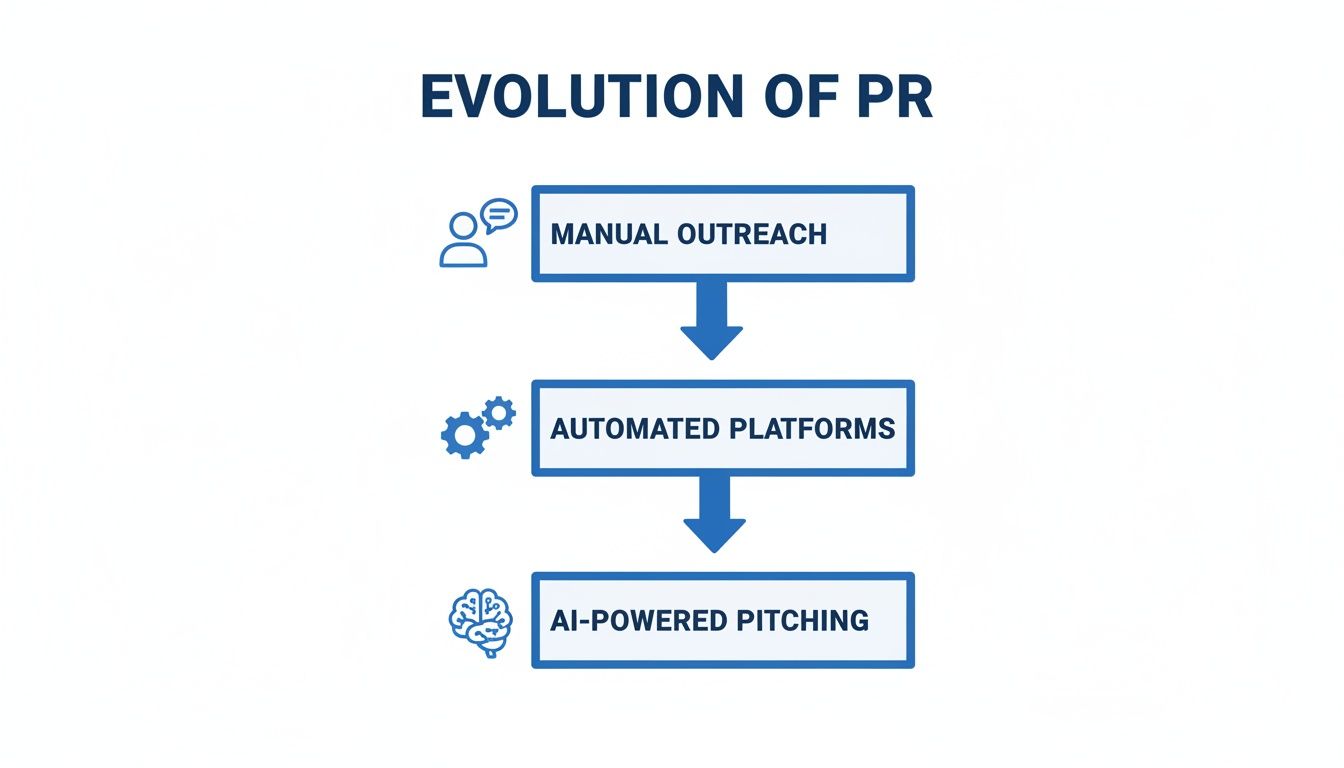
This progression makes one thing clear: each new phase was designed to fix the problems of the last, shifting the goal from just blasting out a message to building real relationships with the right people.
Distribution Method and Reach
The first, and maybe biggest, difference is how these platforms actually send out your news. A traditional newswire like PR Newswire or Business Wire operates on a syndication model. They take your press release and push it, word-for-word, to a huge network that includes wire services like the Associated Press, financial data terminals, and thousands of websites.
This method guarantees your announcement appears in a lot of places. But let's be clear: this is syndicated content, not earned media. The vast majority of these "pickups" are just automated reposts on partner sites, often buried in sections that get very little human traffic. The real value here is for public companies needing to meet disclosure requirements or for making a big funding round feel like it's everywhere at once.
A self-service platform gives you a bit more control. You upload your release, pick some categories like industry or location, and the platform emails it to journalists on its internal list.
It's definitely more targeted than a newswire, but it’s still basically a blast. Journalists get your full press release dumped in their inbox, probably along with a hundred others. The burden is still entirely on them to dig through your text and find a story worth writing.
Then you have AI-powered pitching platforms, like PressBeat, which flip the whole script. Instead of sending the entire release, the system finds the most relevant journalists based on what they've actually been writing about. It then crafts a short, personalized pitch meant to start a conversation, framing your news as a story idea that fits their beat.
This approach is laser-focused on securing earned media—that is, original stories written by journalists. The goal isn't just to get your release posted; it's to inspire a reporter to write their own article about you.
Targeting and Personalization Capabilities
Good PR is all about relevance. Pitching your new SaaS tool to a food critic is a waste of time for everyone involved. This is where targeting and personalization features really separate the good from the bad.
Traditional newswires offer almost no real targeting. Your release goes out to their massive list, and that's that. Their value proposition is reach, not precision.
Self-service platforms are a step up. They let you filter their media lists by a journalist's beat (like "fintech" or "health tech") or by location. It's an improvement, for sure, but the personalization usually ends there. The email the journalist gets is still generic and doesn't show you know anything about their actual work. For a more detailed look at the options out there, checking a list of the best press release distribution services can provide helpful context.
Key Insight: The difference between distribution and pitching is the difference between putting up a billboard and having a conversation. One is a one-to-many broadcast; the other is a one-to-one engagement designed to build a relationship and land a real story.
This is where AI-powered platforms shine. They use machine learning to analyze a journalist's articles, social media, and publishing history. This makes it possible to personalize pitches at scale, maybe by referencing a recent story they wrote or mentioning their specific area of expertise. It's an approach that gets a much better response because it proves you’ve actually done your homework.
Analytics and Performance Measurement
If you can't measure it, you can't improve it. The quality of a platform's analytics is a huge point of difference.
Newswires give you what's called a "clipping report." It's a long list of websites where your press release was syndicated. These reports can look impressive with hundreds of logos, but they don't give you any meaningful data on engagement. You have no idea if anyone actually read it, let alone a journalist.
Self-service tools do a little better, often providing email open and click-through rates. This tells you if a journalist opened your email, but the trail goes cold there. You won't know if they wrote about you unless you happen to stumble upon the article yourself. To see how these tools work in the real world, it's worth reading case studies, like an experiment with a content distribution platform that found success.
AI-driven platforms offer the most useful analytics by far. Their dashboards give you real-time tracking on what matters:
- Pitch Deliverability: Confirming your pitches were successfully sent and delivered.
- Open and Reply Rates: See exactly how many journalists are engaging with your outreach.
- Published Articles: Get direct links to the earned media coverage you've secured. No more manual searching.
- Backlink and SEO Metrics: Track the SEO value of your coverage, including the domain authority of the publications linking back to you.
This kind of detailed data gives you a clear, honest look at your campaign's ROI, turning PR from a guessing game into a measurable growth channel.
Matching the Right Platform to Your Use Case
Choosing a press release distribution platform isn't about finding the "best" one—it's about picking the right tool for the job at hand. The best service for a startup trying to build its name is completely different from what a public company needs for a material announcement.
Your company’s stage, your immediate goals, and the story you're telling all point to a specific type of platform. Getting this match wrong is a fast way to burn through your budget with little to show for it. The key is to connect the platform’s core strength directly to what you need to achieve right now.
For Early-Stage Startups Seeking Credibility
When you're a new startup, your number one PR goal is usually validation. You need to earn trust from customers, investors, and potential hires. In this game, one thoughtful article in a respected industry journal is worth more than 500 automated pickups on websites nobody’s ever heard of.
The focus has to be on securing real earned media that tells your story authentically. This is precisely where mass distribution from a traditional newswire often misses the mark. Journalists are drowning in newswire feeds; they aren’t digging through them to find the next great startup story. They're looking for a sharp, personalized pitch that lands in their inbox.
For startups, PR is about quality over quantity. The goal isn't to be everywhere at once, but to be somewhere that matters. A feature story in a key trade journal builds more credibility than 500 automated pickups on low-traffic news sites.
This is where AI-powered pitching platforms really shine. They're built for making the one-on-one connections that lead to genuine articles.
- Precision Targeting: These tools help you find the specific journalists who have a track record of covering companies just like yours. Your pitch is relevant from the get-go.
- Relationship Building: A personalized pitch starts a conversation. It opens the door for interviews, follow-up questions, and future stories.
- Guaranteed Outcomes: Many modern platforms, including PressBeat, offer guaranteed published articles. For startups on a tight budget needing predictable results, this is a game-changer.
A self-service platform is another option if you're watching every penny, but be prepared to do all the heavy lifting yourself—crafting the perfect pitch, finding contacts, and managing all the follow-up. For founders short on time and PR expertise, the strategic guidance and automation of an AI service is often the clearest path to coverage that counts.
For In-House Teams Scaling Product Launches
When you're an established company with an in-house PR team launching a new product, the game changes. You probably have some brand recognition, so the goal is to create widespread buzz that drives sign-ups and sales. This calls for a mix of broad awareness and a few high-impact stories.
A hybrid strategy is usually the most effective approach here. The team can use a self-service distribution platform to get the announcement out to a wide net of industry blogs, regional outlets, and trade publications. This builds a solid foundation of coverage and boosts SEO with valuable backlinks.
But for the big-name media outlets, a generic press release blast is a non-starter. Your team needs to do targeted, personal outreach to their top-tier journalist contacts. This is where an AI-powered platform can be a massive force multiplier for your internal efforts.
Example Workflow for a Product Launch
- Broad Announcement: Use a self-service tool like eReleases or PRWeb to distribute the main press release to mid-tier industry publications and local media.
- Tier-One Outreach: At the same time, use an AI pitching platform to zero in on the top 20-30 journalists covering your industry at major publications.
- Personalized Pitching: Craft and send personalized pitches to these key contacts, offering them an exclusive angle on the launch.
- Measure and Report: Track both the syndicated pickups and the earned media placements to get a full picture of the campaign's impact.
This two-pronged approach gives you both reach and depth, letting your in-house team work smarter without compromising the quality of their most important outreach.
For Major Announcements Like Funding Rounds
For the big milestones—a major funding round, a merger, or an IPO—the goal is maximum saturation. The news has to hit investors, financial analysts, and the entire business community, and it has to do it fast.
This is the classic job for a traditional newswire service like Business Wire or PR Newswire. Their syndication networks are unmatched, pushing your announcement to financial terminals like Bloomberg and Refinitiv Eikon, national outlets through the Associated Press, and thousands of online news portals.
Here, the value isn't about inspiring a journalist to write a unique story. It's about creating an official, time-stamped record of the news that gets distributed globally. This is crucial for satisfying disclosure requirements and giving the announcement an air of authority.
But even with a newswire, your work isn't done. For a funding round, you still want those in-depth feature stories. The best approach is to supplement the newswire blast with targeted, embargoed outreach to key reporters in the days leading up to the announcement, often handled directly by your team or with help from a PR agency.
How PressBeat Gets You Guaranteed Earned Media
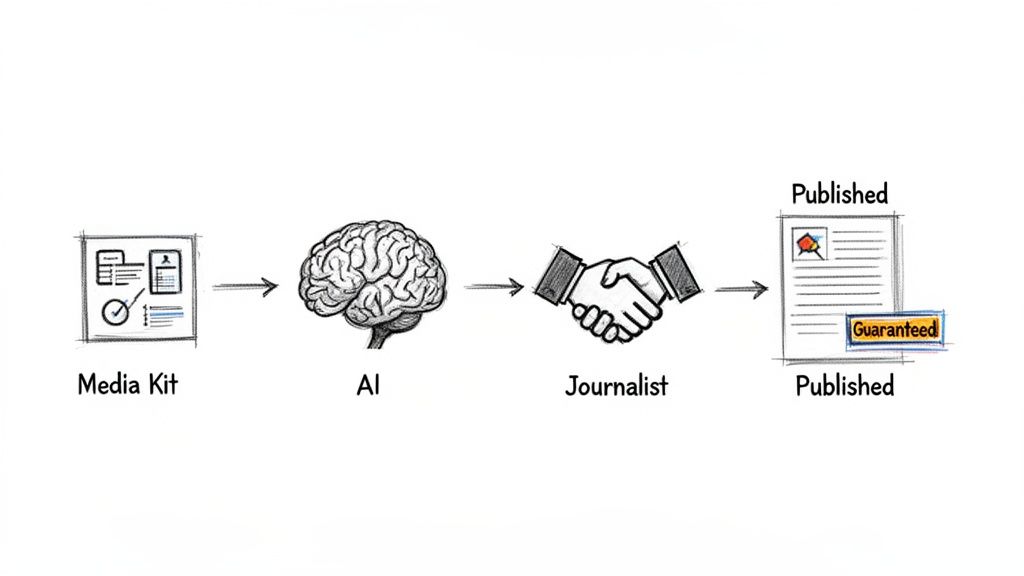
While most press release distribution platforms are built to just broadcast your news, PressBeat works from a completely different playbook. Think of us as a 'PR agency as software,' a system designed to secure guaranteed earned media. That means real articles, written by journalists about your company—not just syndicated copies of your release.
This model was built to fix the biggest frustration with traditional newswires. You pay for distribution, but get zero certainty that any journalist will actually cover your story. Instead of just pushing your full press release out to a massive list, PressBeat uses AI to pinpoint the right journalists and pitch them personalized story ideas they'll actually want to write about.
Everything we do is about precision. Our system finds reporters who have a track record of covering your specific niche, making sure every pitch lands with someone who cares. It's this focused approach that lets us deliver predictable results for companies that can't afford to just hope for the best.
The AI-Powered Pitching Process
The PressBeat workflow is straightforward and transparent, taking the guesswork out of media outreach. We don't start with a long, formal press release. Instead, we begin with a simple media kit containing the essential facts about your announcement.
From there, our process is broken down into a few clear steps:
- Media Kit and Angle Validation: You give us the core info, and our system helps you shape it into a few compelling story angles that will grab a reporter's attention.
- AI Journalist Matching: Our tech scours a global database of journalists, reading their recent articles to find the absolute best fit for your news.
- Personalized Pitch Crafting: The system then writes a short, punchy pitch for each journalist, referencing their specific beat and past work to make it feel personal and relevant.
- Automated Outreach and Follow-Up: PressBeat handles the entire outreach campaign, sending the initial pitch and smart follow-ups without ever spamming an inbox.
The whole time, you can watch the campaign unfold on a real-time analytics dashboard. You get a clear view of which journalists we've contacted, who has opened the pitch, and—most importantly—which publications have published an article about you.
Guaranteed Publications and Direct Relationships
Here's the single biggest thing that sets PressBeat apart: our commitment to results. We guarantee published articles in high-authority media outlets. This promise completely changes the value of a distribution platform, removing the financial risk and uncertainty that come with almost every other PR campaign.
PressBeat was created to solve the core problem with PR tech: a lack of accountability. By guaranteeing earned media placements, we turn PR from an unpredictable expense into a reliable growth engine. You get transparent, agency-level results without the opaque processes or high costs.
We also help you build direct connections. As soon as a journalist responds to one of our pitches, the conversation is handed over to you. This is your chance to build a genuine, long-term relationship with that reporter—an asset that automated syndication could never give you. You get the scale of AI outreach without losing the human touch that is at the heart of great PR.
The press release distribution service market is projected to hit USD 5.21 billion by 2033, largely because companies are demanding measurable results. With 87% of businesses reporting better visibility from well-planned campaigns, the shift toward platforms that deliver tangible outcomes is undeniable. Legacy newswires offer syndication, but modern solutions like PressBeat provide the guaranteed publications and direct journalist relationships that define successful PR today. You can read more about the press release distribution market trends and growth.
Common Questions About PR Platforms
When you're looking into press release distribution, a handful of practical questions always come up. Getting clear answers is the final checkpoint before you invest your time and money, so let's tackle the most common ones we hear.
Think of this as the last step in building a PR strategy that actually works, moving you from simply making noise to getting real, measurable results.
What’s the Difference Between a Newswire and a PR Platform?
People often use these terms interchangeably, but they’re fundamentally different tools for different jobs.
A newswire is essentially a giant broadcast antenna. Its sole purpose is to take your press release and syndicate it, word-for-word, across a vast network like the Associated Press. It hits thousands of websites and news terminals all at once. This is the classic approach for official announcements that need to be everywhere, immediately.
A modern PR platform, on the other hand, is all about targeted outreach. It's less about distribution and more about connection. Instead of just blasting your release out, these tools help you find the right journalists who actually cover your industry. They then help you craft a personalized pitch to get their attention and build a real relationship. The goal here isn't just a copy-paste repost; it's to earn an original story written by a journalist.
Here’s the bottom line: A newswire gets your press release posted in a lot of places. A PR platform helps you get a journalist to write about you. One is mass syndication; the other is earned credibility.
How Do I Actually Measure the ROI of a Press Release?
This is the big one. To measure the return on your PR investment, you have to look past vanity metrics like how many people opened your email. Real ROI is tied to business goals. A good distribution platform will give you analytics that connect your media coverage to actual growth.
Here’s what you should be tracking:
- Website Referral Traffic: Who is clicking through to your website from the articles you landed? This is a direct line from PR to audience engagement.
- Branded Search Volume: Are more people searching for your company by name? A successful PR push almost always creates a spike in brand awareness and search queries.
- Lead Generation: Can you trace new leads or sign-ups back to your media coverage? A simple "How did you hear about us?" on your forms can reveal a ton.
- SEO Impact: Look for high-quality backlinks from the publications that cover your story. These are gold for your website's domain authority and will boost your search rankings over time.
The best platforms give you a dashboard that pulls all this together, so you can easily show the real business value your PR is generating.
Can I Use One of These Platforms Without a PR Team?
Absolutely. In fact, many modern PR platforms are built specifically for founders, marketers, and small teams who are wearing multiple hats. The old-school PR world was built on who you knew and required endless hours of manual outreach. Today’s tools have automated the grunt work.
Platforms like PressBeat are essentially "PR software" that handles the most time-consuming parts for you. You bring the news and the message, and the platform takes care of researching journalists, personalizing pitches, and sending follow-ups. It makes professional-level PR accessible without the six-figure cost of a traditional agency or a full-time hire. It truly levels the playing field.
How Long Does It Take to See Results?
This really depends on the kind of platform you choose. It’s critical to set your expectations correctly based on the method.
With a traditional newswire, results are almost immediate. Within hours, your release is syndicated across its network, and you'll get a report showing hundreds of online placements.
With earned media platforms that rely on direct pitching, the process is slower and more organic. It can take a few days or even a few weeks for a journalist to respond, set up an interview, and publish a story. It requires more patience, but the payoff is a much more valuable and authentic piece of coverage.
Platforms that offer guaranteed publications give you a more predictable timeline. While it still takes time to write and place articles, you know exactly how many you’ll get within a set period, which takes a lot of the guesswork out of the process.
Ready to stop hoping for media coverage and start getting it? PressBeat uses AI-powered pitching to secure guaranteed earned media in high-authority publications. See how our transparent, results-driven platform can build your brand's credibility by visiting https://pressbeat.io.